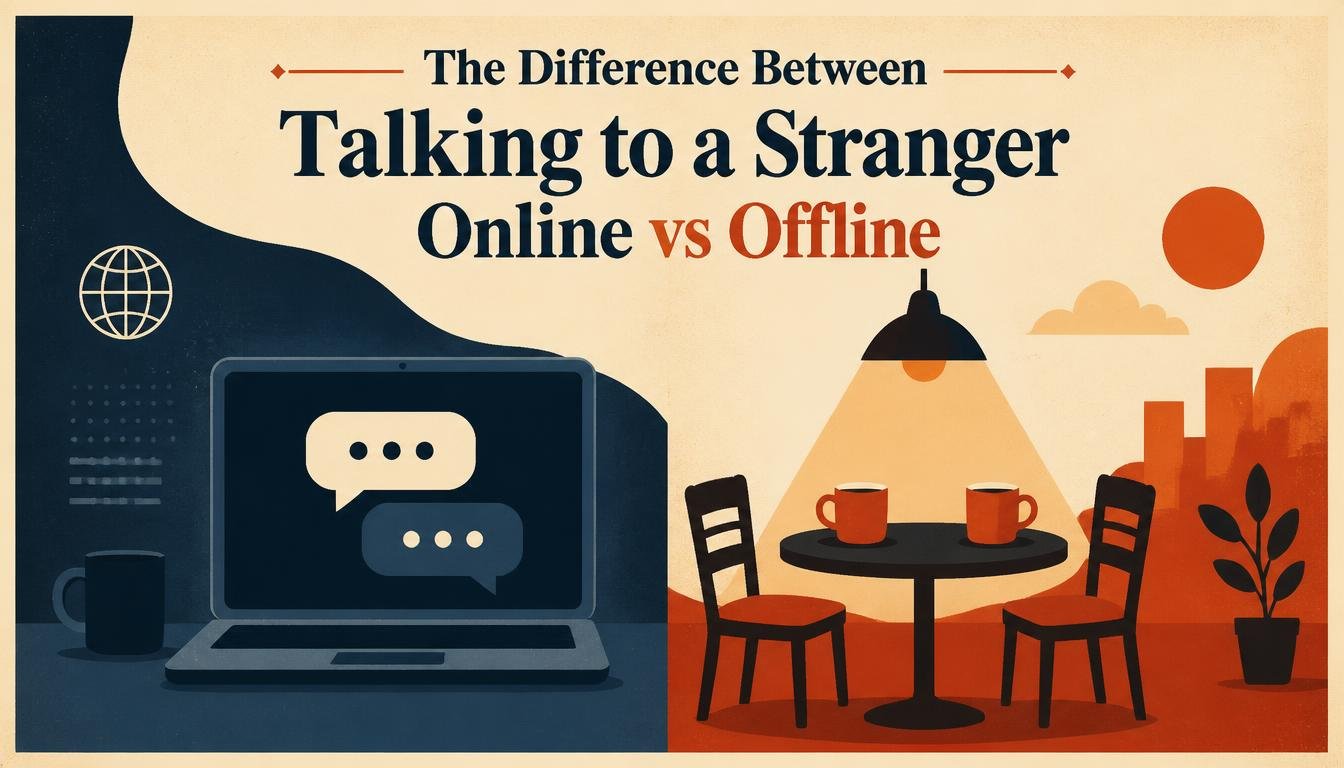
Striking up a conversation with a stranger at a bus stop and opening a random voice call app might look like the same basic act on paper — two people who don't know each other, talking. In practice, they're almost nothing alike. The setting changes everything: what people say, how fast they open up, and what they're even hoping to get out of the exchange.
Offline, There's Always a Reason to Be Cautious
Talking to a stranger in person carries a layer of physical awareness that never fully switches off. Where are you? Is this a safe place? Could this go somewhere uncomfortable? None of that is paranoia — it's just a normal, sensible response to being physically present with someone you don't know. That underlying caution shapes the entire interaction, usually keeping things polite, brief, and fairly surface-level.
Online, especially voice-only, that physical risk simply isn't part of the equation. There's no proximity, no shared space, nothing that could escalate beyond the conversation itself. Removing that layer of caution changes what people are willing to say almost immediately.
Offline Strangers Come With Visual Judgment Built In
In person, a first impression forms instantly based on appearance — clothing, age, expression, posture — long before a single word is exchanged. That visual snapshot inevitably shapes the interaction, whether people mean for it to or not. Online voice conversations skip that step entirely. There's nothing to look at, no visual assumptions to work through first. The impression forms purely from voice and words, which often makes online strangers feel less filtered by surface-level bias than offline ones.
Offline Conversations Are Usually Short by Necessity
Talking to a stranger in real life often has a built-in time limit — the bus arrives, the line moves, the moment passes. These conversations tend to stay light because there's rarely room for them to go deeper before circumstances end them naturally. Online voice calls remove that constraint completely. There's no external event forcing the conversation to end, which gives it room to develop into something longer and more substantial if both people want that.
Online Anonymity Runs Deeper Than Offline Ever Can
Even a stranger you meet in person exists in a shared physical world — you might recognize them again, they might know someone you know, there's a small but real chance your paths cross later. That possibility, however small, keeps a bit of self-editing in place. Online random voice calls remove that possibility almost entirely. There's no shared physical world to run into each other in again, which creates a deeper, cleaner form of anonymity than in-person strangers ever really offer.
Offline Interactions Involve More Sensory Information, Not Necessarily More Honesty
There's a common assumption that in-person conversations are automatically more "real" because you get more sensory information — facial expressions, body language, tone all combined. That's true, but more information doesn't necessarily mean more honesty. People often self-monitor more in person precisely because there's more being observed and judged in real time. Online voice conversation offers less sensory data but often more emotional honesty, because there's simply less to perform for.
The Purpose Is Usually Different
Offline strangers are almost always incidental — you didn't set out to talk to someone new, it just happened because you were both in the same place at the same time. Online random voice calling flips that completely. It's intentional from the very first tap. Both people opened the app specifically to talk to someone new, which changes the entire energy of the interaction. There's no accidental quality to it — both sides showed up wanting exactly this.
Neither Version Is Better, Just Different
None of this makes online conversation superior to offline, or vice versa. Offline strangers offer something online interaction can't — genuine shared physical context, spontaneity, the unpredictable texture of real-world encounters. Online voice conversation offers something offline rarely can — depth without risk, honesty without the pressure of being watched, and a level of anonymity that makes certain kinds of openness far easier to reach.
What This Says About Human Connection
Maybe the real takeaway is that "talking to a stranger" isn't one single experience — it's several different ones, shaped entirely by the conditions around it. Change the setting, remove the visual layer, take away the physical risk, and the entire nature of the interaction shifts along with it. Online or offline, the impulse to connect with someone new stays exactly the same. It's just the shape of that connection that changes completely.