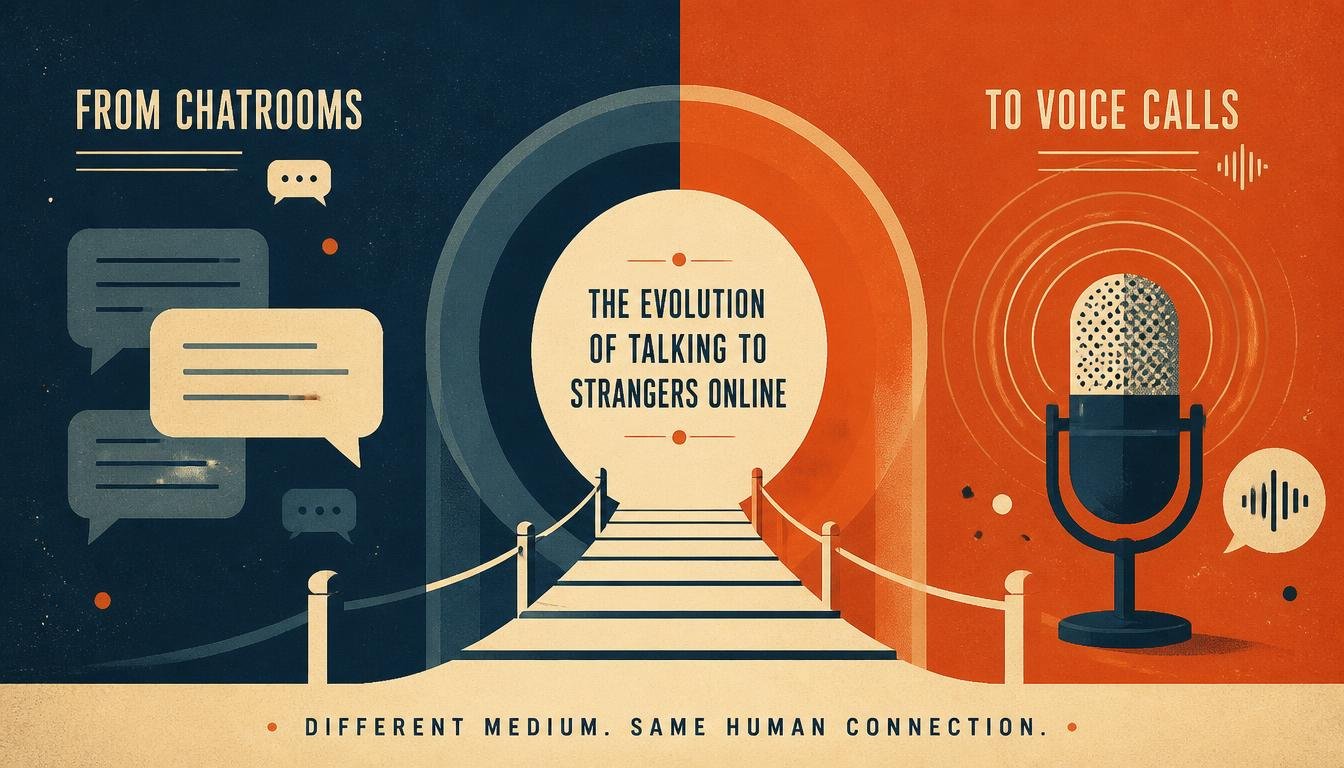
From Chatrooms to Voice Calls: The Evolution of Talking to Strangers Online
If you're old enough to remember dial-up internet, you probably remember the sound of it too — that screeching handshake before the screen finally loaded. And somewhere on the other side of that noise was a chatroom full of strangers typing away under usernames that meant nothing and everything at once.
Talking to strangers online isn't new. It's just changed shape so many times that most people don't realize they're part of a tradition that's been going strong for almost three decades.
The Chatroom Era
Back in the late 90s and early 2000s, chatrooms were where the internet's social life happened. AOL chatrooms, IRC channels, Yahoo Messenger rooms — these were text-only spaces where you'd type a message into a room full of people you'd never met and just see who responded. There was no profile picture, no bio, no verified badge. Just a username and whatever you chose to type.
What made it work was the anonymity. Nobody knew if you were fourteen or forty. You could reinvent yourself completely, try on a different personality, and nobody would ever know unless you told them. It was messy, occasionally chaotic, and completely unmoderated compared to today's standards. But it taught an entire generation that you could form a real connection with someone using nothing but words on a screen.
The Webcam Shift
Then came the mid-2000s, and everything changed with the arrival of webcam-based platforms. Suddenly you weren't just typing to a stranger — you could see them, hear them, watch their reactions in real time. Sites built entirely around this idea exploded in popularity almost overnight. The appeal was obvious: video added a layer of realness that text could never fully replicate. You could tell if someone was actually laughing or just typing "lol."
But video also came with a cost. It removed the safety net that anonymity used to provide. Showing your face to a random stranger is a bigger ask than typing a message, and a lot of people who loved chatrooms never made that jump comfortably.
Enter Voice-Only
Voice calling with strangers is, in a way, a return to something closer to the original chatroom spirit — minus the typing. You get the real-time, human energy of a live conversation: tone, laughter, hesitation, the little sounds that make a conversation feel alive. But you keep the layer of anonymity that made those early chatrooms so freeing in the first place. Nobody sees your face. Nobody screenshots you. You're just a voice, which somehow makes people more willing to actually say what they're thinking.
There's also something practical about it. Video calls demand attention — you have to look decent, sit somewhere presentable, stay in frame. A voice call doesn't ask any of that. You can talk to a stranger while walking, lying in bed, or doing dishes. It fits into life in a way video never quite managed to.
Why This Evolution Makes Sense
Every shift in this history follows the same underlying pattern: people want connection, but they want to control how much of themselves they reveal while getting it. Chatrooms offered full anonymity but limited depth. Video offered depth but demanded exposure. Voice calling sits right in the middle — enough presence to feel human, enough distance to feel safe.
It's not that one format replaced the other completely. Chatrooms still exist in different forms, video chat still has its audience, and text messaging strangers hasn't gone anywhere either. But voice calling has carved out its own space precisely because it solved a problem the earlier formats never quite figured out — how to feel truly heard without having to perform for a camera.
The Constant Underneath It All
What's interesting is that the technology keeps changing, but the reason people do this hasn't moved an inch in twenty-five years. People still want to talk to someone who doesn't know them, who won't judge them by their history, who they can be completely honest with for ten minutes and then never think about again. Chatrooms gave people that space with a keyboard. Voice calls give it to them with nothing but their own voice.
The format keeps evolving. The need behind it never really does.