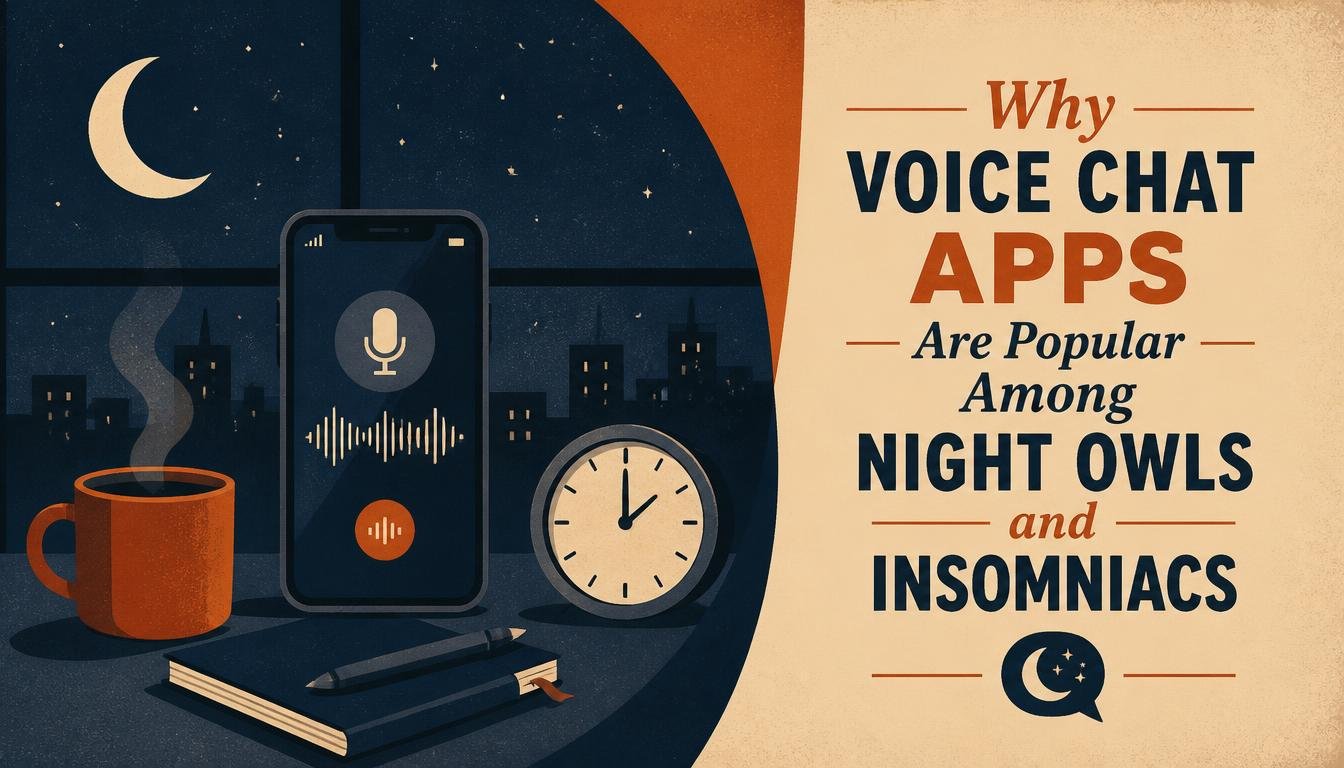
There's a specific kind of quiet that shows up around 2 a.m. — the rest of the house asleep, the street outside empty, nothing but the glow of a phone screen and a mind that refuses to switch off. For a lot of night owls and people who struggle to fall asleep easily, this hour is painfully familiar. And increasingly, it's the exact hour when random voice chat apps see some of their busiest activity.
That's not a coincidence. Late-night hours create a very specific kind of loneliness, and voice chat apps have quietly become one of the more common ways people fill it.
Everyone Else Is Asleep, But You're Not
One of the hardest parts of being awake at 3 a.m. isn't the wakefulness itself — it's the isolation that comes with it. Texting a friend feels off-limits; they're asleep, and waking them up over nothing feels inconsiderate. Social media feeds thin out and stop refreshing with anything new. The usual outlets for connection basically shut down for the night, leaving late-night thoughts with nowhere to go.
Random voice calling solves that specific problem in a way almost nothing else does — because the pool of users spans every time zone, there's always someone else awake somewhere, ready to talk, no matter what time it is where you are.
A Racing Mind Often Wants a Voice, Not Silence
For people whose minds tend to speed up right when they're trying to wind down, silence can actually make things worse. A quiet room gives every anxious or looping thought more room to get louder. A conversation, even a casual one with a stranger, gives the mind something else to focus on — a genuine distraction that's more engaging than scrolling, because it requires actual back-and-forth attention instead of passive consumption.
This is part of why so many people describe feeling calmer after a late-night call, even a short one. It's not that the conversation solved anything specific. It's that having somewhere to direct restless mental energy, even briefly, can quietly ease the loop.
Late-Night Conversations Tend to Go Deeper, Faster
There's a noticeable shift in how people talk during late-night hours compared to daytime chatter. Guards tend to be lower. Conversations move toward more honest, sometimes more vulnerable territory faster than they would during a quick afternoon call. Tiredness has a way of stripping away some of the usual social filtering, and there's something about the late hour itself that seems to give permission for a more unguarded kind of honesty.
Night Owls Find Each Other More Often Than Chance Would Suggest
Because these apps run on a global pool, someone who's naturally a night owl in their own time zone is statistically likely to be matched with someone equally awake and equally restless somewhere else in the world. Over time, this creates a strange sense of community among people who are simply built to be awake at hours when most of their own circle isn't. There's a specific kind of comfort in talking to someone who understands, without needing an explanation, why you're still up.
It's a Better Alternative to Doomscrolling
For a lot of late-night users, the honest comparison isn't between talking to a stranger and getting proper sleep — it's between talking to a stranger and endlessly scrolling a feed instead. Between those two options, an actual conversation, however brief, tends to feel more genuinely satisfying than passive scrolling, and often ends with a clearer sense of closure instead of the vague, unsettled feeling that comes from closing an app after an hour of mindless scrolling.
A Gentle Note on Sleep
None of this is meant to suggest random voice calling is a fix for ongoing sleep struggles — if trouble sleeping is a frequent, persistent pattern, that's worth mentioning to a doctor rather than working around indefinitely. But for the occasional restless night, having a low-pressure way to talk to someone rather than lying there alone with racing thoughts is a reasonable, human response to a very common problem.
The Simple Truth Behind the Pattern
At its core, this isn't really about apps or technology. It's about the fact that being awake and alone at 3 a.m. is a specific, uncomfortable kind of lonely that most of the world sleeps right through. Voice chat apps didn't invent the late-night ache for connection — they just happened to build something that finally answers it, one random, wide-awake stranger at a time.