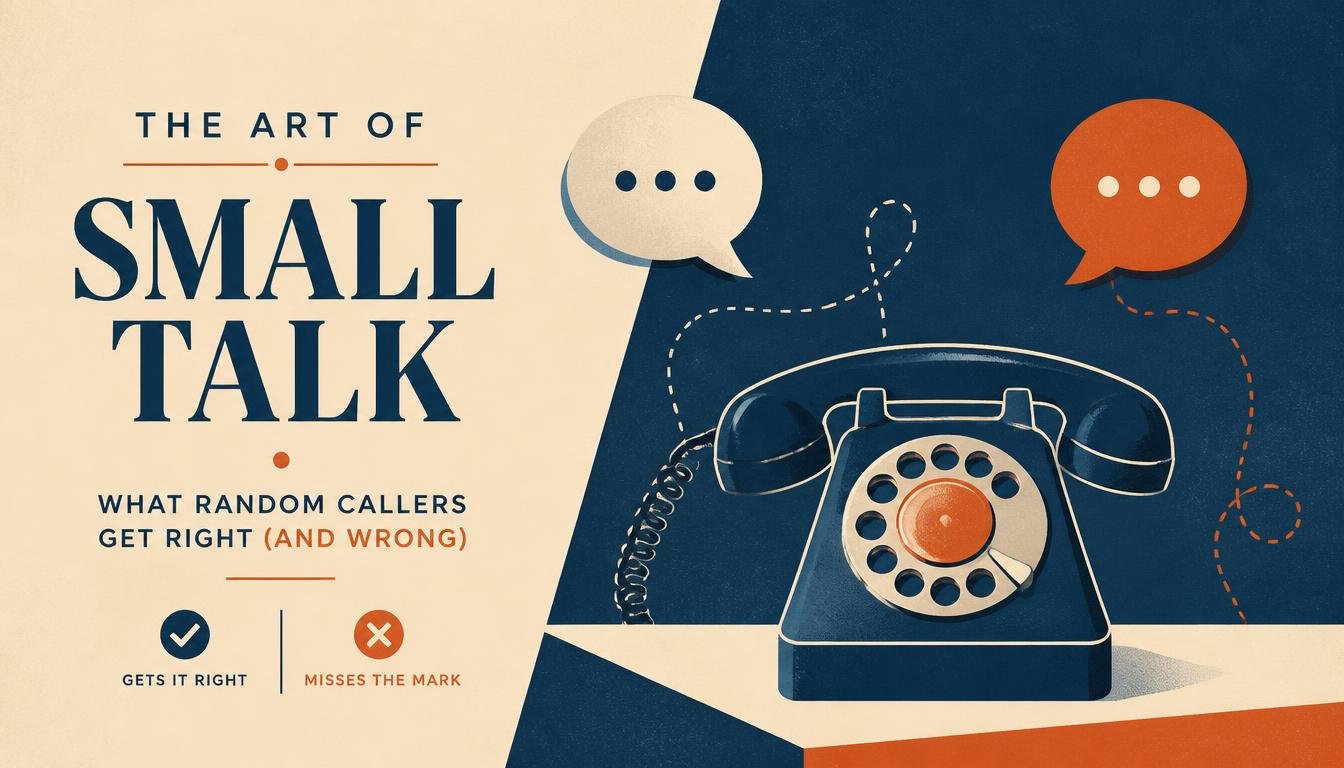
The Art of Small Talk: What Random Callers Get Right (and Wrong)
Small talk gets a bad reputation. People roll their eyes at "the weather" as a topic, treat it like the boring tax you pay before a real conversation starts. But spend time on random voice call apps and you'll notice something surprising: small talk isn't the problem. Bad small talk is. There's a real skill hiding inside those first thirty seconds of a call, and most people never stop to notice it — they either nail it without thinking or completely blow the conversation before it has a chance to start.
Here's what separates the two.
What Random Callers Get Right
They ask questions that are easy to answer. The calls that go well almost always start light. "What are you up to right now?" "Is it late where you are?" These are questions anyone can answer without thinking too hard, and that matters more than people realize. A stranger's brain needs a low-effort entry point before it's willing to open up further. Jumping straight into something heavy skips a step most people aren't ready for yet.
They react instead of just responding. There's a difference between "oh cool" and actually reacting to what someone said — laughing at the right moment, sounding genuinely surprised, asking a natural follow-up. The best small talk on these apps doesn't feel scripted because it isn't. It's just someone paying real attention and letting their reaction show instead of holding a flat, polite tone the whole time.
They let silence exist without panicking. Good callers don't treat a two-second pause like an emergency. They let it sit, then either build on what was just said or offer something new. Rushing to fill every gap with noise usually makes a call feel more anxious than it needs to be.
They treat the small talk as the point, not a hurdle. This might be the biggest one. People who are good at this don't see small talk as something to get through before the "real" conversation starts. They treat the small stuff — a comment about background noise, a joke about the time zone difference — as worth enjoying in itself. Ironically, that's usually what makes a conversation turn into something deeper. Nobody opens up to a person who seems bored by the warm-up.
What Random Callers Get Wrong
Going too personal, too fast. This is probably the single most common mistake. Someone picks up, and within the first minute they're being asked about relationship status, past heartbreak, or deeply personal opinions. It's not that those topics are off-limits — it's that timing matters. Depth has to be earned through a few exchanges first, not demanded upfront.
Interviewing instead of conversing. A string of unconnected questions — age, location, job, hobbies, repeat — feels less like a conversation and more like filling out a form. The other person starts to feel like they're being processed rather than talked to. Good conversation branches naturally off what was just said instead of jumping to the next item on a mental checklist.
Talking at someone instead of with them. Some callers use the anonymity as an excuse to just talk — about their day, their opinions, their problems — without checking in on the other person at all. It can feel less like a conversation and more like being used as an audience. A little back-and-forth goes a long way toward making the other person feel like an actual participant.
Forcing energy that isn't there. Not every stranger wants an upbeat, high-energy exchange, and pushing that tone onto someone who's clearly tired or distracted usually backfires. Reading the other person's actual mood and matching it, instead of steamrolling past it, tends to lead to much better calls.
Why This Actually Matters
Small talk isn't filler. It's a test — a quick, low-stakes way for two strangers to figure out if this conversation is worth continuing, and it happens whether people realize it or not. Nail those first thirty seconds and a random call can turn into something genuinely memorable. Get it wrong, and the other person is already mentally reaching for the "next" button, no matter how interesting the rest of the conversation might have been.
The people who are naturally good at this aren't doing anything complicated. They're just curious, comfortable with a little silence, and willing to actually listen instead of waiting for their turn to talk. Turns out that's most of what small talk — and honestly, most conversation — really is.