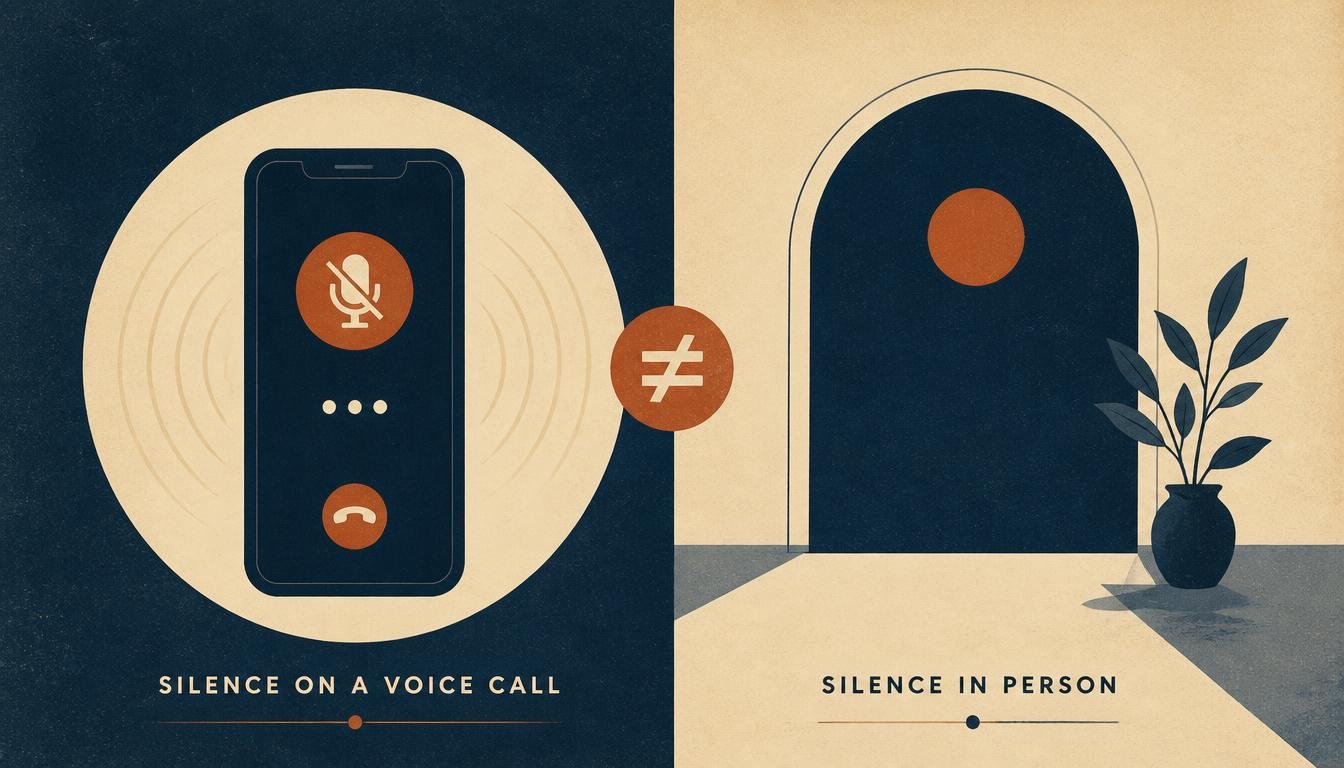
Silence on a Voice Call: Why It Feels So Different From Silence in Person
Two people sitting in a room can go quiet for a full minute and it barely registers. Maybe they're both looking at their phones, or just enjoying being near someone without the pressure to fill every second with words. Comfortable silence, in person, is one of the easiest things in the world.
Put those same two people on a voice call, and thirty seconds of nothing suddenly feels enormous. Someone starts wondering if the call dropped. Someone clears their throat just to prove they're still there. It's the same amount of quiet, and yet it lands completely differently. There's a real reason for that, and it says a lot about how strange voice-only communication actually is compared to what humans evolved to handle.
In Person, Silence Has Context. On a Call, It Doesn't
When you're physically with someone, silence comes with information. You can see their face, their posture, whether they're relaxed or thinking or just tired. Silence in person is rarely truly empty — it's filled with a hundred small visual signals that tell you exactly what's going on without a single word being said.
A voice call strips all of that away. All you have is sound, or the absence of it. When the sound stops, there's no posture to read, no expression to check. Your brain, deprived of its usual cues, defaults to assuming the worst: did they hang up? Are they annoyed? Did the connection break? Silence stops being neutral and starts being a question mark.
The Brain Treats Missing Audio as a Warning Sign
There's a reason silence on a call triggers a small jolt of anxiety that silence in a room doesn't. Humans are wired to expect a certain rhythm in spoken conversation — a back-and-forth cadence that's been baked into us since we first learned to talk. When that rhythm breaks unexpectedly, especially without any visual explanation, the brain interprets it as something going wrong, even when nothing actually is.
This is part of why people on calls often rush to fill even the smallest pause with a nervous "yeah" or "so..." — not because they have something to say, but because the alternative, sitting in that ambiguous quiet, feels uncomfortable in a way it simply doesn't when you're face to face.
Random Calls Make This Even More Intense
On a call with someone you know well, a pause can still feel relatively safe — you have enough history to assume good intent. On a random voice call with a total stranger, that safety net doesn't exist yet. A pause early in the conversation can feel loaded with uncertainty: is this person bored, thinking, distracted, or gone entirely? Without any relationship to fall back on, the brain has nothing to reassure it that the silence is fine.
This is exactly why so many random calls end abruptly the moment things go quiet — not because the conversation was actually bad, but because the silence felt unbearable to at least one person, and hanging up felt easier than sitting with the discomfort.
Learning to Sit in It Changes the Conversation
Here's the interesting part: the callers who get comfortable with silence tend to have noticeably better conversations. A pause doesn't have to mean something's wrong. Sometimes it just means the other person is thinking, or genuinely enjoying a quiet moment instead of performing constant chatter. Letting a few seconds pass without panic, without rushing to fill it, often gives the other person space to come back with something more thoughtful than they would have under pressure to respond instantly.
It's a small skill, but it changes the entire feel of a call. Conversations that allow for natural pauses tend to feel more relaxed and more real than ones where both people are talking simply to avoid the discomfort of stopping.
What This Reveals About Voice-Only Connection
Silence on a call isn't actually empty — it's just unfamiliar. Humans have thousands of years of practice reading silence in person and almost none reading it through a phone speaker. That mismatch is why something as small as a five-second pause can feel so loaded on a call, even though it would mean absolutely nothing sitting across from someone in a room.
Once you understand that, silence on a random voice call stops being something to fear and starts being just another part of a real conversation — because real conversations, the kind worth having, were never meant to be nonstop noise in the first place.