How Random Voice Calls Help Introverts Practice Social Skills
Ask most introverts what they dread about social situations and it's rarely the talking itself. It's the walk into the room. The scanning of faces. The pressure of being watched while you figure out what to say. Take all of that away and just leave the conversation part, and something interesting happens — a lot of introverts turn out to be genuinely good talkers. They just needed the rest of the noise removed first.
That's basically what a random voice call does, and it's a big part of why so many introverts find these apps oddly comfortable, even therapeutic, in a way in-person socializing rarely is.
No Eye Contact to Manage
For a lot of introverts, eye contact is quietly exhausting. It's not that they can't do it — it's that maintaining it while also thinking of what to say next takes real effort, effort that extroverts often don't even notice they're not spending. Voice calls remove that entirely. There's no face to hold steady, no need to look interested on the outside while your brain is working on the inside. That alone frees up a surprising amount of mental space to actually focus on the conversation itself.
Low Stakes Make Practice Actually Possible
Practicing social skills in real life usually means practicing in front of people who matter — coworkers, classmates, people you'll see again and whose opinion of you sticks. That pressure makes real-life practice feel less like practice and more like a performance with real consequences if it goes wrong.
Random voice calls flip that completely. If a conversation goes badly, there's no one to face again tomorrow, no reputation on the line, no awkward run-in at the next event. That low-stakes environment is exactly what skill-building actually needs — a space to try things, mess up, and try again without real consequences following you afterward.
It Builds the Habit of Starting
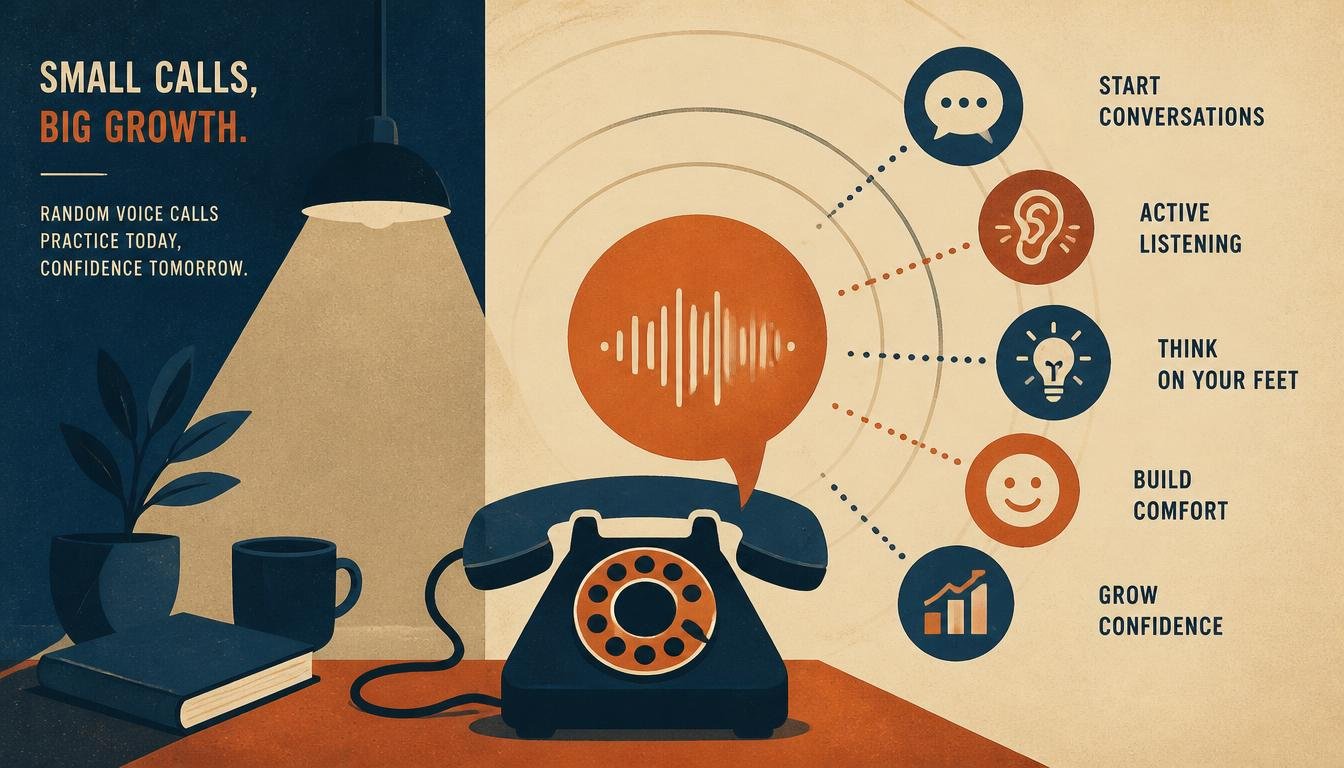
For a lot of introverts, the hardest part of any conversation isn't sustaining it — it's starting it. That first "hey, how's it going" carries disproportionate weight, because it's the moment of highest uncertainty. Random voice calls force that moment to happen constantly. Every single call starts exactly there, over and over, which turns something that used to feel like a big hurdle into something closer to routine.
Silence Doesn't Feel as Loaded
In face-to-face interactions, especially first meetings, a pause can feel like a spotlight. Everyone's watching, and the silence seems to say something about you. On a voice call, that pressure softens. A short pause doesn't carry the same visible weight, which makes it easier to actually think before responding instead of blurting something out just to fill space. Over time, that small shift teaches a more relaxed relationship with silence in general — one that can carry over into real-life conversations too.
It Rewires the Fear of Rejection, One Small Repetition at a Time
Introverts often avoid initiating conversations because the fear of rejection feels disproportionately large compared to the actual risk. Random voice calls offer a strange kind of exposure therapy for that fear. Calls end constantly — sometimes mid-sentence, sometimes for no clear reason at all — and after enough repetitions, that outcome stops feeling catastrophic. It becomes just... a thing that happens sometimes. That shift, learned through repetition rather than willpower, quietly lowers the emotional cost of social risk in general.
A Safe Place to Test a More Talkative Version of Yourself
Some introverts describe feeling like a slightly different, more talkative version of themselves on these calls — not fake, just less guarded. Without the visual pressure of in-person interaction, it becomes easier to experiment with being a little more expressive, a little quicker to laugh, a little more willing to ask questions. That version of themselves doesn't disappear after the call. A lot of people find it easier to bring a bit of that same confidence into real-life conversations once they've had enough practice finding it somewhere lower stakes first.
Not a Replacement, But a Genuine Stepping Stone
None of this means random voice calls are a substitute for real-world social interaction, and most introverts using these apps aren't trying to avoid people entirely. It's closer to a training ground — a space to build comfort with talking, starting conversations, and sitting through silence, all without the sensory overload that in-person socializing often brings. For a lot of introverts, that practice space ends up making real-life interactions feel just a little less draining than they used to.
Sometimes the easiest way to get more comfortable talking to people isn't forcing yourself into every room. It's finding a low-pressure way to practice first — and a random voice, on the other end of a call, turns out to be exactly that.