Long before apps, before smartphones, before the internet existed in any recognizable form, there was a version of this same idea running through late-night radio. Someone would dial in, wait on hold, and eventually get a few minutes on air talking to a host and an audience of total strangers about whatever was on their mind. No video, no names most listeners would remember, just a voice reaching out into the dark to talk to people it would never actually meet.
Random voice calling apps didn't invent this feeling. They just took it off the airwaves and put it directly into people's hands.
The Original Appeal Was the Same
Call-in radio shows worked for the same basic reason random voice apps work now: people wanted to talk, to be heard, to say something out loud to someone other than the four walls of their room. Late-night shows in particular built entire followings around this — insomniacs, night-shift workers, and lonely listeners tuning in specifically because there was nowhere else to send that late-night restlessness. The format wasn't really about music or news. It was about voice as company.
The Big Difference: One Voice to Many vs. One Voice to One
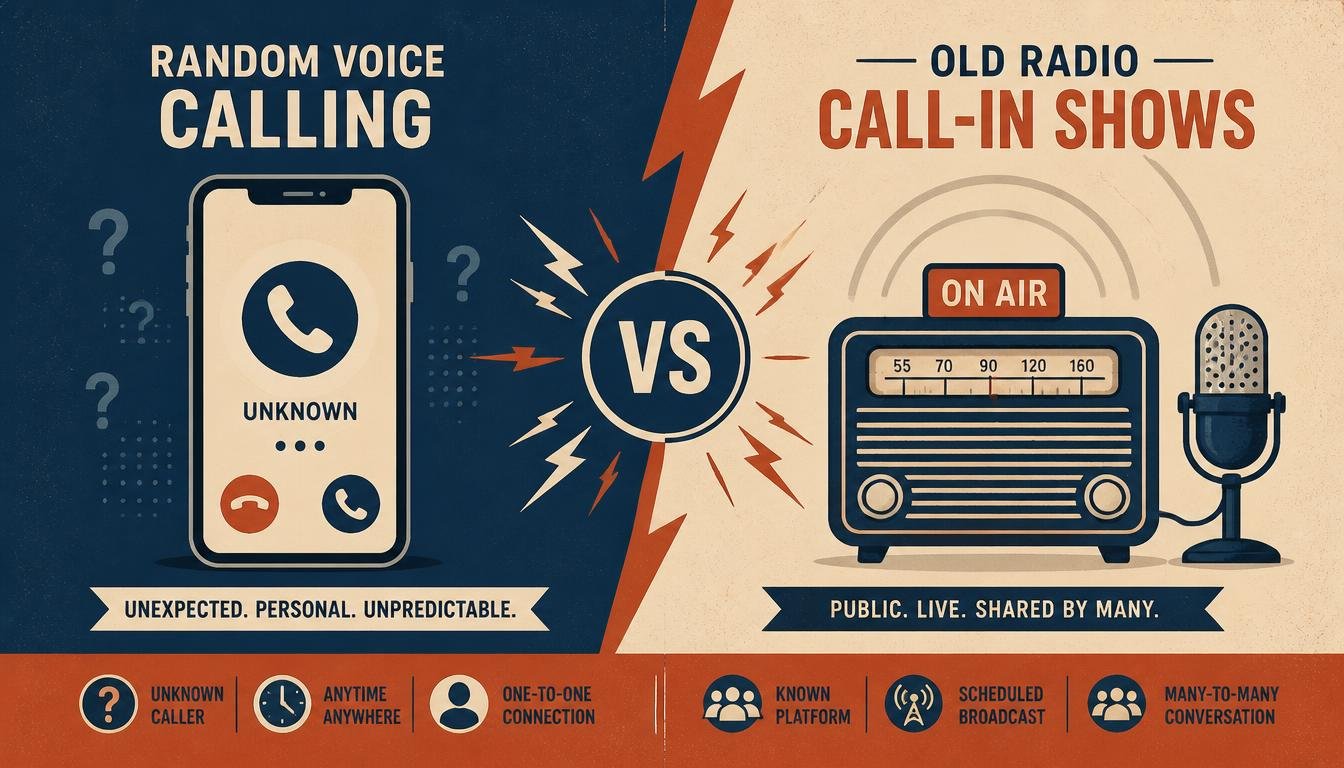
The biggest structural difference is obvious once you think about it. Radio call-ins were broadcast — one caller, heard by potentially thousands of listeners, filtered through a host who controlled the conversation and decided what stayed on air. It was public performance dressed up as intimacy. You were talking to one host, but performing for an invisible audience the entire time.
Random voice calling flips that completely. It's one voice talking to exactly one other voice, with nobody else listening in, no host managing the exchange, and no invisible audience shaping what you're willing to say. That shift, from broadcast to private exchange, changes everything about how honest people are willing to be.
No More Waiting on Hold
Anyone who remembers actually trying to get through to a call-in show remembers the waiting — sometimes twenty minutes, sometimes never getting through at all before the show ended. The entire experience was gated by limited airtime and a producer deciding who got to speak. Random voice apps removed that gate completely. There's no hold time, no producer screening you, no chance of never making it on air. You want to talk to someone, you tap a button, and it happens in seconds.
The Host Is Gone, and So Is the Filter
Radio call-in shows always had someone steering the conversation — a host who'd cut you off, redirect the topic, keep things moving for the audience's benefit. That structure gave the format a certain safety net, but it also meant your conversation was never really yours. It belonged to the show.
Random voice calls have no host, no editor, no format to fit into. The conversation goes wherever the two people take it, for as long as both want it to last. That lack of structure is either the best or the most disorienting part, depending on who you ask — but it does mean the conversation genuinely belongs to the two people having it, and nobody else.
Anonymity Worked Differently Back Then
Radio callers were usually anonymous to the audience, but not fully — hosts often knew names, sometimes cities, and callers were speaking into a public space where family or coworkers might genuinely be listening at that exact moment. There was always a small risk of being recognized. Random voice apps offer a cleaner version of anonymity: no name required, no risk of a coworker tuning in by accident, nothing tying the conversation back to your actual identity unless you choose to share it.
The Constant That Never Changed
What's striking, looking at both formats side by side, is how little the core motivation has shifted across decades. People in the 1980s dialing into a late-night show and people today opening a random voice app are chasing the exact same thing — a voice on the other end that doesn't already know them, doesn't judge them by their history, and is willing to just listen for a few minutes.
The technology went from a phone line and a broadcast tower to an app that fits in a pocket. But the reason someone picks up either one hasn't changed at all. Some nights, people just need to talk to someone, and it doesn't particularly matter who's on the other end — as long as someone's actually there.