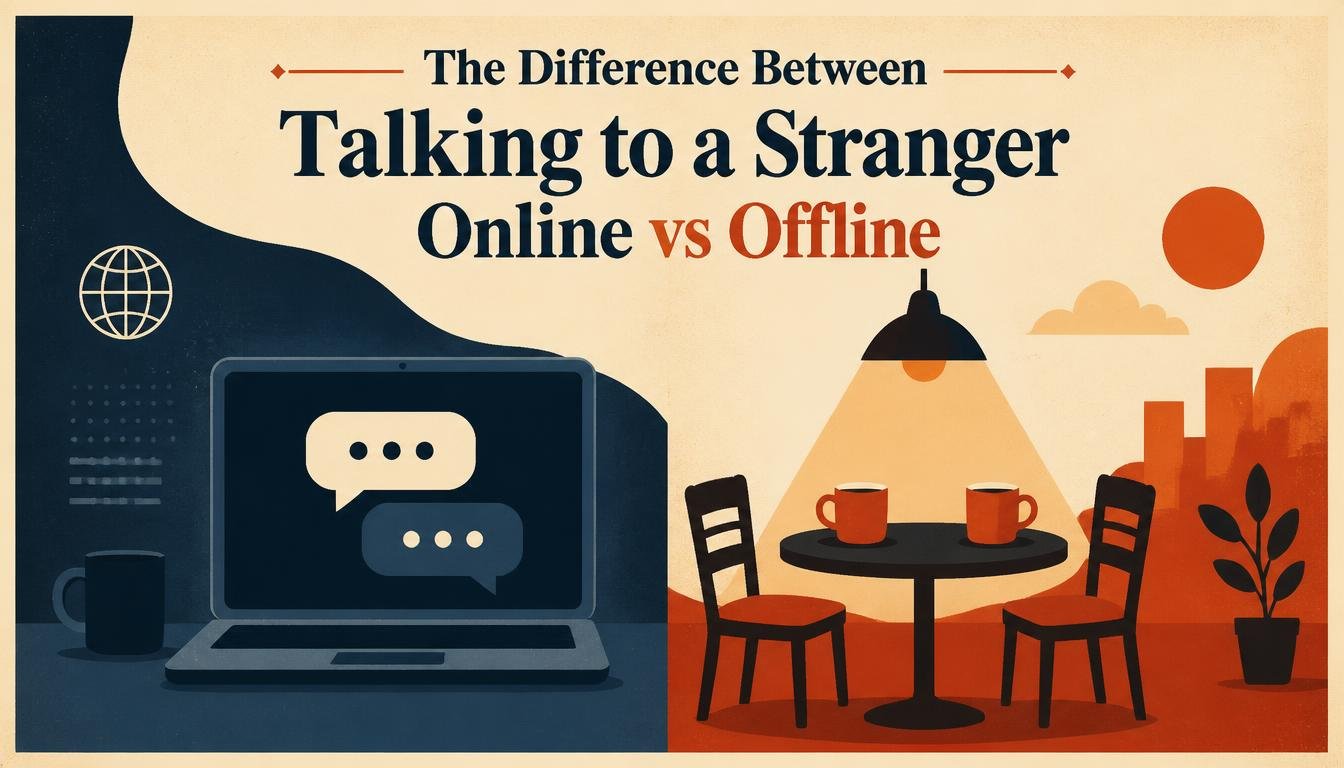
Why Talking to Strangers Changes You
We are conditioned from childhood not to talk to strangers. But decades of psychological research tell a different story: brief, positive encounters with strangers increase happiness, creativity, and a sense of social belonging — sometimes more than conversations with friends and family. Because it's similar conversation like friends family and also neighbours
Random voice chat platforms create millions of these stranger encounters every day. Here is what actually happens to people who do it regularly.
1. Your Worldview Literally Expands
When you speak to someone from a country you have never visited, you get a window into a reality you could not access from any news article or documentary. The person's immediate experience — what they did today, what they worry about, what they find funny — is uniquely humanizing in a way that abstractions about countries and cultures are not.
Regular random chat users consistently report developing more nuanced views of other countries and cultures, and less susceptibility to simplistic stereotypes.
2. You Become a Better Listener
Talking to strangers requires more careful listening than conversations with people you know. You cannot fill in gaps from shared history. You cannot assume context. You have to actually hear what the person is saying. This practice, repeated over many calls, builds genuine listening skills that transfer to all your relationships.
3. Small Talk Becomes Less Painful
Many people dread small talk — the surface-level conversation that feels tedious and hollow. But regular random chat practice teaches you that small talk is actually a skill, and that most people are more interesting than they initially appear. The question "where are you from?" has launched some of the most fascinating conversations random chat users report having.
4. You Get More Comfortable With Silence
Not every moment of a conversation needs to be filled. Random chat teaches this forcefully — sometimes there is just silence, and neither person immediately knows what to say. Learning to be comfortable in those moments, rather than anxiously filling them with noise, is a genuinely useful social skill.
5. You Realize How Similar People Are Everywhere
Despite surface differences in language, culture, religion, and geography, random chat users routinely report discovering how universal certain human experiences are: the desire for connection, the fear of judgment, the love of humor, the importance of family. This is not a cliché — it is something you feel viscerally when you experience it in a real conversation.
6. Your Empathy Increases
Hearing someone describe their daily reality — their city, their struggles, their dreams — in their own voice is more empathy-generating than any amount of reading about a topic. Voice carries emotion in ways that text simply cannot. Regular exposure to diverse human experience builds genuine empathic capacity.
7. Some Calls Are Surprisingly Deep
The anonymity of random chat creates an unexpected paradox: because neither person has anything to lose and will likely never talk again, people sometimes share things more honestly than they would with people they know. The "stranger on a train" phenomenon — where people confide in strangers precisely because they are strangers — is real and common in random voice chat.
8. You Improve at Thinking on Your Feet
Random conversations require improvisation. You do not know what the other person will say, what direction the conversation will go, or what knowledge gaps will surface. Navigating this in real time, repeatedly, builds cognitive flexibility and improves your ability to think and respond quickly in other contexts.
9. Occasional Calls Are Genuinely Funny
Laughter with a complete stranger is one of the most genuinely joyful experiences random chat offers. Shared humor across cultural and linguistic barriers, emerging spontaneously from a random connection, is delightful in a way that is hard to describe and easy to experience.
10. Loneliness Decreases
This is the most consistently reported outcome among regular random chat users. The platform does not create lasting friendships — that is not its purpose. But the repeated experience of genuine human contact, of being heard by another person, of brief mutual interest and attention — has measurable effects on the sense of being connected to humanity. Even short positive interactions reduce feelings of isolation.
FAQ
Is it psychologically healthy to talk to strangers online regularly?
Research suggests that positive brief social interactions — even with strangers — have well-documented benefits for mood and sense of social belonging. The key is that interactions are positive, not anxiety-inducing. If you find random chat stressful rather than interesting, it may not be the right activity for you.
Can random voice chat replace real-world social connection?
No, and it should not. Random chat is a supplement to social life, not a replacement for it. Deep human connection requires continuity, shared experience, and mutual vulnerability that brief anonymous conversations cannot provide. Use it as a complement to, not a substitute for, in-person relationships.
How do I avoid the negative experiences (rude people, silence, bad calls)?
Disconnect immediately from any call that is negative, rude, or uncomfortable. There is no social obligation. The next call is one click away. The ratio of good to bad calls improves significantly with experience, as you get better at steering conversations quickly.
Experience it yourself: Start a random voice call — completely free, no signup required.