Millions of people open random chat apps every day not because they are bored — but because they are lonely, anxious, or simply craving a real human voice. Random voice chat platforms like RandomVoiceCall have quietly become a mental health tool for many users, often without anyone framing them that way.
But is talking to strangers online actually good for your mental health? The answer, like most things in psychology, is: it depends. This article examines both sides — the genuine benefits and the real risks — so you can make an informed decision about whether anonymous voice chat belongs in your life.
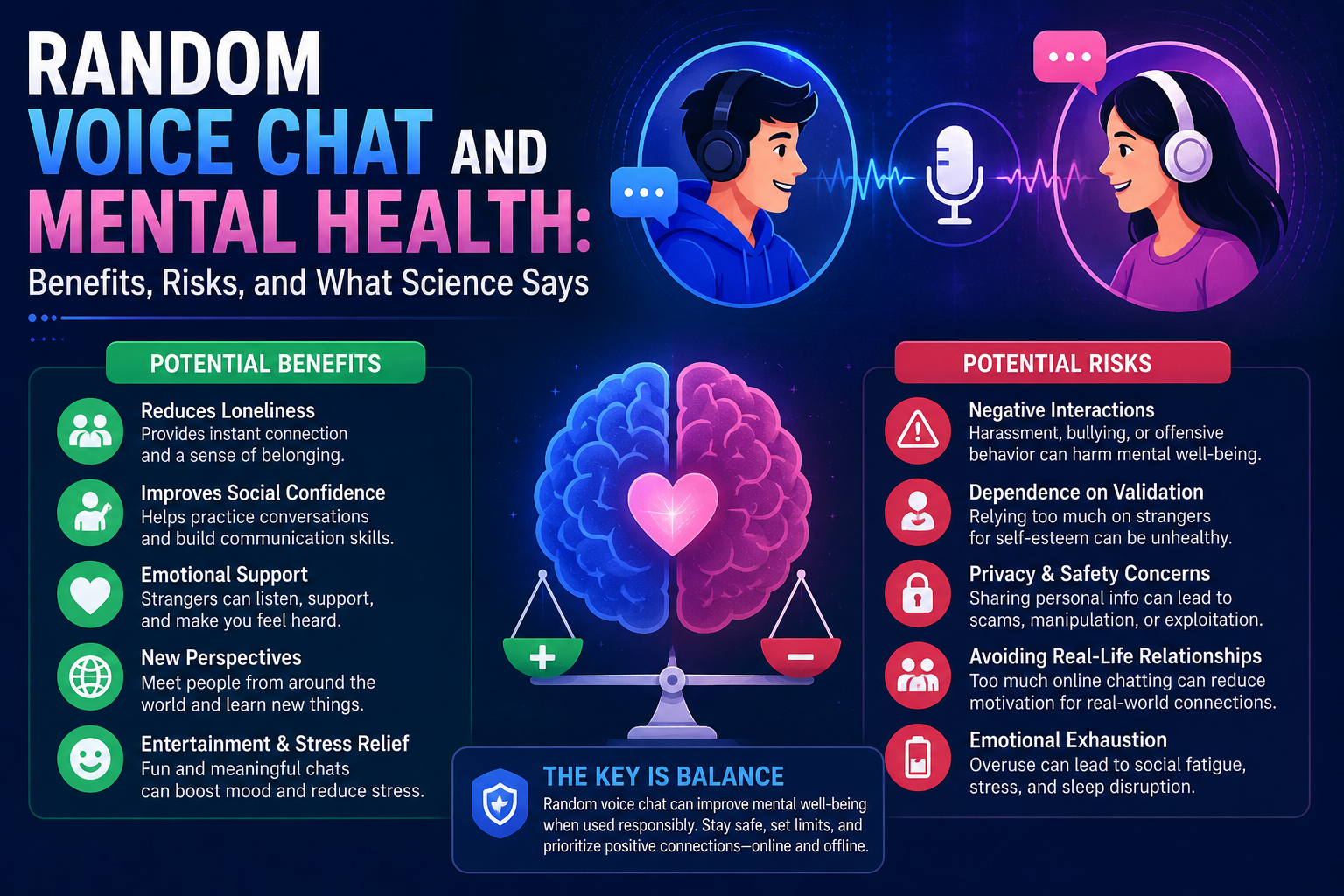
The Mental Health Benefits of Random Voice Chat
1. It Reduces Loneliness — Even Brief Conversations Help
Loneliness is one of the most pressing public health crises of the modern era. Research from the American Psychological Association has repeatedly shown that social isolation is as harmful to long-term health as smoking 15 cigarettes a day. The key finding: it is not the depth of social connection that matters most — it is the frequency of positive social contact. It can be you unlucky day if you can meet person on this.
Random voice chat provides exactly that. A five-minute conversation with a stranger in another country still activates the same social brain systems as a long conversation with a close friend. For people who are isolated — whether due to disability, social anxiety, remote living, or circumstance — these micro-connections genuinely matter.
2. It Builds Social Confidence Without High Stakes
Social anxiety affects roughly 12% of people at some point in their lives. One of the core treatment strategies, backed by cognitive-behavioural therapy, is graduated exposure — practising social interaction in low-stakes environments until it feels manageable.
Anonymous voice chat is uniquely well-suited for this. You can practise starting conversations, holding attention, expressing opinions, and ending calls gracefully — all without any lasting consequence if it goes badly. The anonymity removes the fear of social judgement that makes real-world socialising so difficult for anxious people.
Many users report that regular use of random voice chat improved their ability to hold conversations in real life — not because the platform is therapy, but because repetition builds competence and competence reduces anxiety.
3. It Offers a Pressure-Free Space to Talk
One underappreciated aspect of talking to strangers is the absence of social history. When you speak to a friend, colleague, or family member, every conversation is loaded with shared context, expectations, and history. With a stranger, there is none of that.
This makes it genuinely easier for some people to talk honestly. Research on the "strangers on a train" phenomenon — where people share deeply personal things with strangers they will never see again — suggests that anonymity lowers psychological defences in a way that can be genuinely cathartic.
For someone who needs to process a difficult emotion but does not want to burden their social circle, a random voice call can serve as a low-pressure outlet.
4. It Exposes You to Different Worldviews
Psychological research consistently links cognitive flexibility — the ability to see situations from multiple perspectives — with better mental health outcomes, including lower rates of depression and anxiety. One of the fastest ways to build cognitive flexibility is to regularly engage with people whose life experiences differ radically from your own.
Random voice chat, by connecting you with people from different countries, cultures, and socioeconomic backgrounds, provides exactly this. Users frequently report that conversations with strangers challenged assumptions they did not know they held — a form of informal perspective-taking that is genuinely healthy.
5. It Can Restore a Sense of Human Connection During Hard Times
During periods of grief, depression, or major life transition, people often withdraw from their existing social networks — either because they do not want to burden others, or because their usual social world feels disconnected from their current emotional state.
Random voice chat provides an escape valve. You are not asking anything of anyone you know. You are simply connecting with another human being who has no preconceptions about who you should be. For some users, this is genuinely restorative.
The Mental Health Risks of Random Voice Chat
1. It Can Substitute for Real Relationships Rather Than Supplement Them
The biggest psychological risk of any anonymous social platform is substitution: using it instead of building deeper relationships, rather than alongside them. Random voice chat is excellent for the benefits described above, but it cannot replicate the long-term emotional benefits of stable, reciprocal relationships with people who know your history.
If you find yourself preferring random calls to maintaining existing friendships — or if the platform is becoming a way to avoid the vulnerability of real relationships — that is worth examining honestly.
2. Repeated Negative Interactions Can Reinforce Social Anxiety
Graduated exposure therapy only works if the exposures are positive or neutral. A series of hostile, dismissive, or disturbing interactions can have the opposite effect — reinforcing the belief that social contact is dangerous or unpleasant.
Random voice chat platforms, by their nature, expose you to the full range of human behaviour. Most interactions are neutral or positive. But some users — particularly those who are already vulnerable — may have negative experiences that worsen rather than improve their social anxiety. Using platform safety features (the ability to end calls instantly, report users) is important for this reason.
3. Anonymity Can Enable Harmful Behaviour — and Harmful Exposure
The same anonymity that makes random voice chat liberating for most users makes it a space where some people behave in ways they would not in real life. Explicit content, harassment, and attempts at manipulation occur on all random chat platforms.
For users with histories of trauma, harassment, or boundary violations, encountering this kind of content can be genuinely distressing. It is important to know that you can end any call immediately and that doing so is not failure — it is appropriate self-protection.
4. It Can Become Compulsive
The variable-reward structure of random matching — you never know who you will get next — activates the same neurological pathways as slot machines. Each new match is a small dopamine hit of anticipation. For some users, this can become compulsive: spending hours in random calls as a way of managing boredom, anxiety, or loneliness rather than addressing the underlying issue.
If you notice that you are using random voice chat in a way that interferes with sleep, work, or offline relationships, it may be worth stepping back.
5. False Intimacy and Emotional Investment in Strangers
Because anonymity lowers psychological defences, some users disclose deeply personal information to strangers very quickly — and then feel a sense of loss or rejection when the call ends. The brevity and randomness of the format means that a conversation that felt meaningful to you may have been entirely transactional to the other person.
This is not harmful for most people, but users who struggle with attachment or abandonment issues should be aware of this dynamic.
Who Benefits Most From Random Voice Chat
- People with social anxiety who want low-stakes practise with real conversations
- People living alone or in isolated environments who lack regular social contact
- Language learners who want genuine conversational practise with native speakers
- Curious, extroverted people who genuinely enjoy meeting strangers and hearing new perspectives
- People going through transitions (new city, post-breakup, post-loss) who need connection without obligation
Who Should Be More Cautious
- People with trauma histories who may be vulnerable to distressing content
- People who struggle with compulsive behaviour patterns
- People who are using it primarily as avoidance — a way to feel connected without doing the harder work of building real relationships
- Young people whose social development may be better served by offline connection
Practical Guidelines for Healthy Use
- Set a time limit before you start. Decide in advance how long you will use the platform. Open-ended sessions are more likely to become compulsive.
- End calls that feel wrong immediately. You owe strangers nothing. If a conversation makes you uncomfortable, end it.
- Use it as a supplement, not a substitute. Random voice chat works best alongside — not instead of — real-world social connection.
- Notice how you feel after sessions. If you consistently feel worse after using the platform, that is important information.
- Do not share identifying information. Protect your privacy to maintain the psychological safety that makes anonymous chat beneficial.
The Bottom Line
Random voice chat is neither a mental health tool nor a mental health risk by itself — it is a technology whose effects depend almost entirely on how you use it. Used intentionally, with awareness of the risks, it can genuinely reduce loneliness, build social confidence, and provide meaningful human connection for people who need it. Used compulsively, or as a substitute for deeper connection, it can reinforce exactly the problems it feels like it is solving.
The conversations are real. The anonymity is real. Whether those conversations make your life better is up to you.