How Anonymous Conversations Reveal Truths People Hide From Friends
I have a friend. Let's call her Priya. She's funny, successful, and has a circle of friends who genuinely adore her. Last week, she told me something that broke my heart. "I've never told anyone this," she whispered, "but sometimes I feel like I'm failing at everything. I smile so much that my cheeks hurt, and inside, I'm just... tired."
I was stunned. Priya is the one who posts motivational quotes. The one who plans trips, remembers birthdays, and always knows what to say. How could she feel like a failure?
Then she told me who she'd actually confessed this to first. Not her best friend. Not her sister. Not even her therapist. A complete stranger on an anonymous voice chat app. Someone who didn't know her name, her face, or her carefully curated Instagram life.
And honestly? That made perfect sense to me.
The Heavy Mask We All Wear
Here's the uncomfortable truth: we lie to the people closest to us. Not maliciously. Not even consciously most of the time. But we edit ourselves. We smooth out the rough edges. We present the version of ourselves that we think others want to see.
With friends, there's history. There are expectations. There's the weight of "you're always so strong" and "you're the one who has it together." Once people see you a certain way, it feels impossible to shatter that image. You become a prisoner of your own reputation.
I've done it. You've done it. We all have.
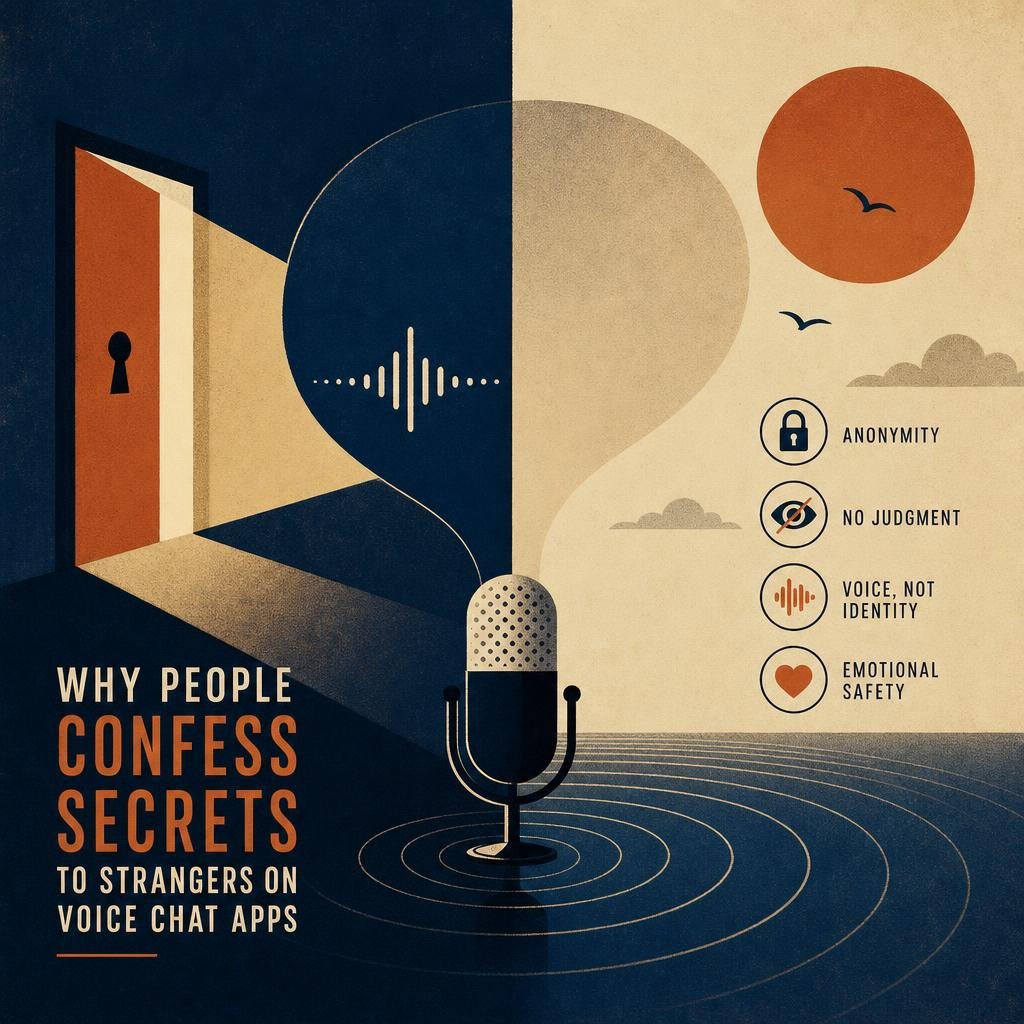
But with an anonymous stranger? There's no reputation to protect. No history to uphold. No mask to maintain. You can say the thing you've been choking on for years, and the worst that happens is a stranger says "that's rough" and moves on. No awkward follow-up texts. No pitying glances at the next dinner party.
The Freedom of No Consequences
A few months ago, I had a voice call with someone who told me they hated their job. Not just disliked—hated. They'd been working in corporate finance for twelve years, making excellent money, and they felt like a ghost inhabiting someone else's life. They'd never told their wife, their parents, or their colleagues. Because what would that change? Their wife would worry. Their parents would be disappointed. Their colleagues would judge.
But they told me. A stranger. Why? Because I had no power over their life. I couldn't fire them, judge them, or spread their secret to their social circle. I was a safe container for their truth.
That's the beautiful, strange gift of anonymous conversations. They offer something rare in our hyper-connected world: consequence-free honesty. You can try on a version of yourself that doesn't exist in real life. You can admit the dark thought, the forbidden desire, the shameful feeling—and watch it not destroy you.
The Self You Hide From Yourself
Here's where it gets even weirder. Sometimes, anonymous conversations reveal truths you didn't even know you were hiding from yourself.
I once talked to someone who was convinced they were happy in their relationship. They described their partner as wonderful, kind, supportive. But as they spoke, their voice kept dropping on certain words. Their pauses stretched a little too long. And after forty minutes of talking to me—a stranger with no skin in the game—they suddenly went quiet.
"Oh," they said softly. "I think I'm actually really unhappy."
They hadn't admitted that to themselves until they said it out loud to someone who didn't matter. Because it's safer to test a painful truth on a stranger. If they reject it, who cares? They don't know your mother. They don't have your college roommate's number. They can't hold it against you.
The Comparison Trap That Doesn't Exist
With friends, there's always comparison. Subtle, unspoken, but present. We measure our struggles against theirs. "She just bought a house, I can't tell her I'm drowning in credit card debt." "He's always so confident, I can't admit I have panic attacks before meetings."
Anonymous strangers are blank slates. You don't know if they're richer, poorer, happier, or more miserable. You can't compare yourself to them because you don't have the data. And that lack of comparison is actually freeing. You can just... be. Without measuring, without competing, without feeling less than.
I had a conversation with a man from somewhere in Europe—I never caught where—who talked about his fear of becoming his father. He was terrified of repeating the same mistakes. He'd never told his siblings because they'd either laugh it off or validate the fear in a way that would make it worse. But he told me. And I just listened. No advice. No judgment. No "but you're so much better than him." Just a stranger holding space.
He later thanked me and said, "I think I just needed to hear it out loud to know it wasn't a monster under my bed."
The Dark Side
I'd be lying if I said every anonymous conversation is beautiful. Some people use anonymity to be cruel. To say things they'd never dare say with their real name attached. There's a toxic version of this too—the troll, the bully, the person who mistakes honesty for brutality.
But here's what I've learned: you can usually tell within the first thirty seconds which one you're dealing with. The ones who come with genuine curiosity, a little nervousness, a hint of vulnerability? Those are the ones carrying heavy truths they've been too afraid to speak elsewhere. The ones who come with aggression, sarcasm, or cruelty? They're hiding too—just from themselves.
The Gift of Being Nobody
At the end of the day, anonymous conversations remind us of something we forget: we are not our reputations. We are not our Instagram feeds. We are not what our friends think of us. We are messy, complicated, contradictory, and beautiful. And sometimes, we need to say the thing we can't say to anyone else—just to prove to ourselves that it's real, that it's okay, that we're still standing after we say it.
Priya told me she felt lighter after her anonymous call. She didn't solve anything. She didn't get advice. She just got to say the quiet part out loud, and the world didn't end.
Maybe that's all we really need sometimes. Not solutions. Just permission.
Permission to be real, even if only for a few minutes, with someone who will never know your name.